


Is the Great Barrier Reef Dying? Coral Bleaching Explained
TL;DR: Bleached coral is not dead coral. The Great Barrier Reef has been through repeated mass bleaching events since 2016, and the most recent monitoring found coral cover holding steady or increasing slightly across all three regions. Conditions vary enormously reef to reef, which is why what a specific boat’s guests see on a specific day matters more than the national headline.
Most people searching this question are trying to decide whether to book a trip at all. They’ve seen the headlines, they’ve got a week in Cairns, and they don’t want to spend $250 looking at a graveyard.
So here’s the honest answer, and it comes in two parts.
The reef is under real, sustained pressure from marine heatwaves, and that pressure is increasing. Anyone telling you otherwise is selling something.
And: it is still one of the most extraordinary places you can put your face in the water, the coral cover on monitored reefs has held up better through the last two years than the headlines suggested, and what you’ll see depends far more on which reef you visit than on what year it is.
Both things are true at once.
What coral bleaching actually is
Coral is an animal that houses algae. The algae, called zooxanthellae, live inside the coral’s tissue, photosynthesise, and hand most of the resulting energy to their host. They’re also what gives coral its colour.
When water gets too warm for too long, the relationship breaks down. The coral expels the algae. What’s left is the transparent coral tissue over a white calcium carbonate skeleton, which is why bleached coral looks bone white.
The coral is still alive at that point. It’s starving, not dead. If the water cools within a reasonable window, the algae recolonises and the coral recovers its colour and its energy supply. If the heat stress continues too long, the coral dies and gets overgrown by turf algae, which is what a genuinely dead reef looks like: brown, fuzzy and flat, not white.
That distinction matters because photographs of bleached coral get published as photographs of dead coral, and they’re not the same thing.
The reef’s bleaching history
| Year | What happened |
| 2016 | First of the modern back-to-back mass bleaching events, severe in the north |
| 2017 | Second consecutive year, hitting the central region |
| 2020 | Widespread bleaching across all three regions |
| 2022 | First mass bleaching recorded during a La Niña year |
| 2024 | Mass bleaching event with significant coral loss following |
| 2025 | Sixth mass event since 2016, and the first time the Great Barrier Reef and Ningaloo bleached in the same year |
That’s the pattern, and it’s the reason for the concern. Events that were once a generational occurrence are now happening every few years, which shortens the recovery window between them.
What the most recent monitoring shows
The Australian Institute of Marine Science surveys 121 reefs annually as part of its Long-Term Monitoring Program. Its most recent annual summary, covering surveys between August 2025 and June 2026, found:
- Hard coral cover increased slightly or stayed similar to the previous year across all three regions
- 28% of surveyed reefs increased in coral cover, 56% showed no net change, and 16% declined
- Late-season monsoon activity increased cloud cover and cooled sea temperatures, which limited the severity of bleaching over the 2025/26 summer
That’s a recovery signal, not a recovery. Coral cover rebuilding after a bad event is normal and expected. What matters is whether the gaps between events stay long enough for it to keep happening.
What you’ll actually see on a day tour
This is the part the headlines can’t answer, because it depends on the site.
Our vessels run to outer-reef sites out of Cairns, and the specific sites vary by boat and by daily conditions. The outer reef generally sits in deeper, better-flushed water than inshore reefs, which gives it more thermal buffering during a heat event.
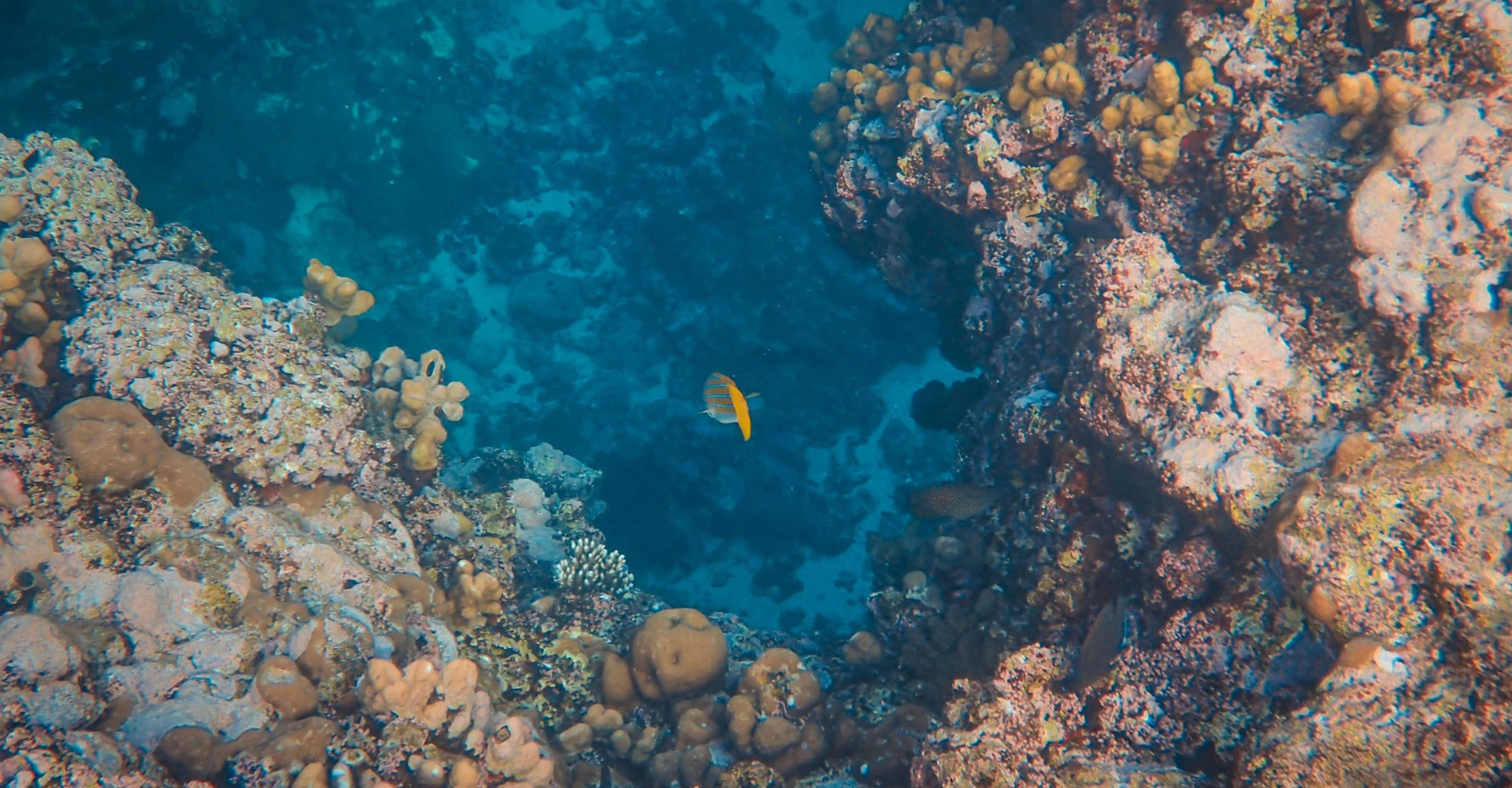
On a typical day out you’ll see healthy hard and soft coral, reef fish in numbers, and giant clams. You’ll also see patches that are recovering, and sections where staghorn coral has been broken up by cyclones. That mix is normal. A reef in good condition is not uniformly perfect any more than a healthy forest is uniformly green.
Why location matters so much
The Great Barrier Reef is 2,300 kilometres long and made of roughly 3,000 individual reefs.
A bleaching event never affects all of it evenly. Heat stress concentrates by region, by depth and by local water movement. In a bad summer, one reef can be severely bleached while another 40 kilometres away, sitting in a stronger current, comes through with minor damage.
The AIMS survey data shows this directly: in the same year, 28% of surveyed reefs gained coral cover while 16% lost it. Both numbers describe the same reef system in the same year.
So a headline about “the reef” is describing an average across an area the size of Italy. It’s true, and it tells you almost nothing about what you’ll see on a specific boat on a specific day.
What the industry and government are doing
The Great Barrier Reef Marine Park Authority (GBRMPA) runs in-water and aerial monitoring across the marine park and publishes reef health updates through the summer. AIMS runs the long-term monitoring surveys that produce the coral cover figures.
Crown-of-thorns starfish control is the other major program. Crown-of-thorns are a native coral predator that periodically outbreaks and can strip a reef faster than bleaching. Control vessels operate across high-value tourism and ecological reefs, culling starfish by hand. It’s unglamorous, labour-intensive work and it’s one of the few interventions with a clearly measurable effect on coral cover.
Reef tourism operators feed observations back into these programs. Boats are on the water every day, which makes crews a genuinely useful early-warning network.
So should you go?
Yes, and go with someone who’ll tell you what you’re looking at.
The most useful thing on a reef trip isn’t the boat or the gear, it’s a guide who can point at a patch of pale coral and tell you whether it’s bleaching, whether it’s recovering, and what the site looked like two seasons ago. That turns a swim into an understanding of what’s happening out there, which is worth more than a reassuring brochure.
Our reef tours run to outer-reef sites out of Cairns, with snorkelling equipment, reef taxes and meals included on the standard day trips, and crew who’ll answer this question honestly rather than deflecting it.
Frequently asked questions
No, but it’s under serious and increasing pressure. It has been through six mass bleaching events since 2016. The most recent AIMS monitoring found coral cover increasing slightly or holding steady across all three regions. The long-term risk from marine heatwaves is real, and the reef today is still a functioning ecosystem worth visiting.
Bone-white coral that still holds its shape and structure. Dead coral looks different: brown and fuzzy, covered in turf algae, with the structure breaking down.
Yes, if the water cools within a reasonable window. The coral is alive but starving during bleaching, and the algae can recolonise. Prolonged heat stress is what kills it.
Yes. Conditions vary enormously between sites, outer-reef sites out of Cairns generally sit in better-flushed water, and a guide can show you what’s healthy and what’s recovering on the day.
It changes season to season, and no honest operator will give you a fixed answer. AIMS publishes regional condition reports, and the crew on any given boat will know their own sites best. Ask when you book.
Sustained heat stress, most commonly from marine heatwaves during summer. Water that stays above the coral’s tolerance for too long triggers the expulsion of the algae. Poor water quality and cyclone damage compound the problem.
Six mass events since 2016, which is a sharp increase on the historical record. Events in 2016, 2017, 2020, 2022, 2024 and 2025 are the ones on that list.
GBRMPA and AIMS run monitoring programs across the marine park, crown-of-thorns starfish control vessels operate on high-value reefs, and water quality programs target agricultural runoff on the mainland. Tourism operators contribute daily observations.
Other Tips & Articles

Check out our other Great Barrier Reef Tours


